
This article is from Habitus Magazine #66. Find out more and subscribe!
Art-filled, delightfully quirky, sculpturally robust and materially splendid, Hannah St Hotel is an immersion in Melbourne that feels just right.
Parked alongside an off-ramp of the Queensbridge in Melbourne’s Southbank, it is a location that few would embrace. But then again, most aren’t the dream combination of Fraser & Partners and Flack Studio. Taking the location for exactly what it is, the architecture leans into the space created by the ramps and access points to feel completely surrounded by air.
The great views across the city and to the Yarra River are one thing, but what will really make this location shine is Melbourne City’s plans to develop the space below the bridge as a landscaped entertainment space. Effectively, what feels decidedly gritty at present (think of all the underbridge movie scenes of car chases and nefarious goings on), will become a garden oasis and fitting entrance to the hotel. At present, a prescient bit of guerrilla painting has turned the pillars and large dots on the road musk-stick pink.
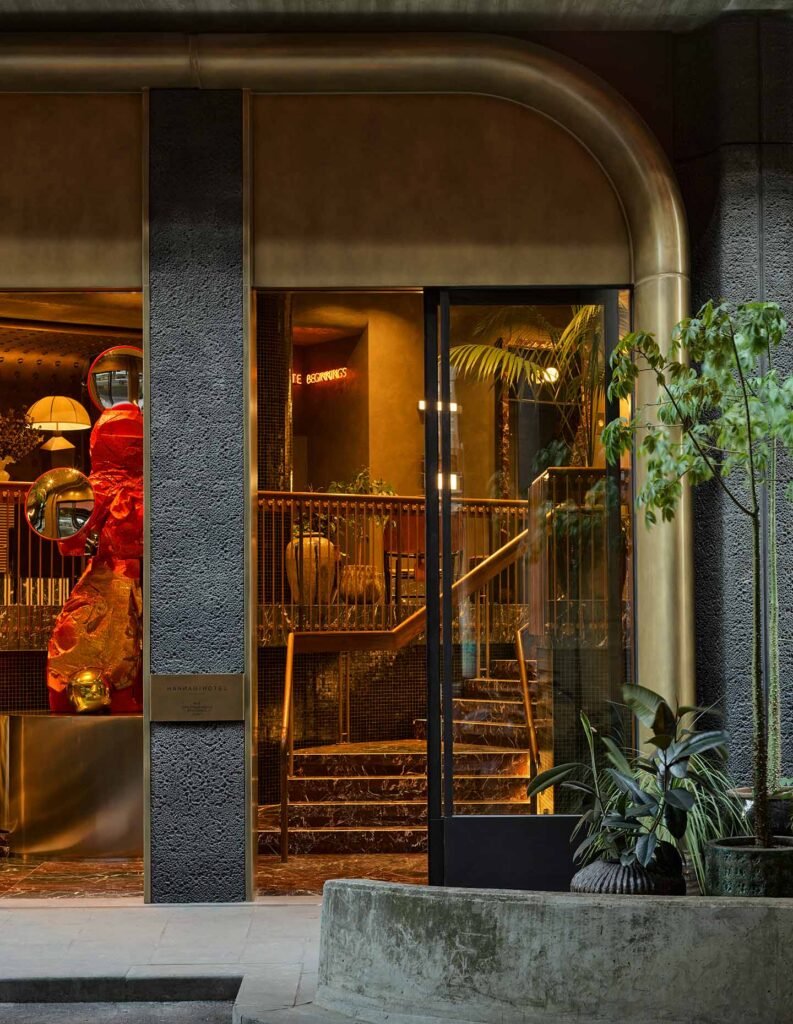
This future transformation aside, the arrival is kind of fun and definitely feels like Lower Manhattan or Brooklyn with the rattle of industry close at hand. Designed so that you arrive on a lower floor below a two-storey void, the entrance is both grand and intimate. A huge artwork, Mirror Sheila, 2024, by Justene Williams, holds the entry portal with verve. The work, a massive transmorphic figure in red and gold with the convex mirrors you find at garage entries, is wholly suited to both the scale and location beside the bridge. It is also fun and good, which is a welcome change from the typical pastiche of lobby art.
The art collection throughout the hotel, overseen by Flack Studio’s principal David Flack and general manager Sam Barrow, is astoundingly well curated. There are a great many highlights – Disobedience and Positive Thinking, 2023, by Marion Abraham is a ripper – but it is the Jo Duck photography in each of the rooms that is particularly fun. Posing people in somewhat ridiculous costumes and masks, her highly chromatic images run from finger-pistol cowboys (Cowboys at Sunset, 2019) to action figures cruising (Spiderman Waits in Corolla, 2021).
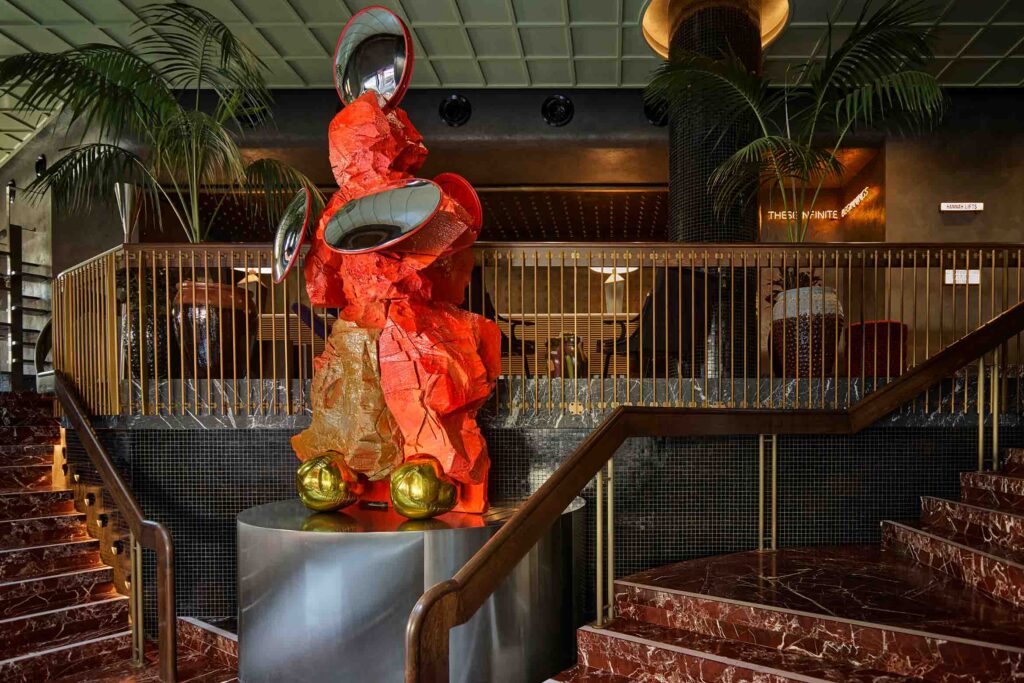
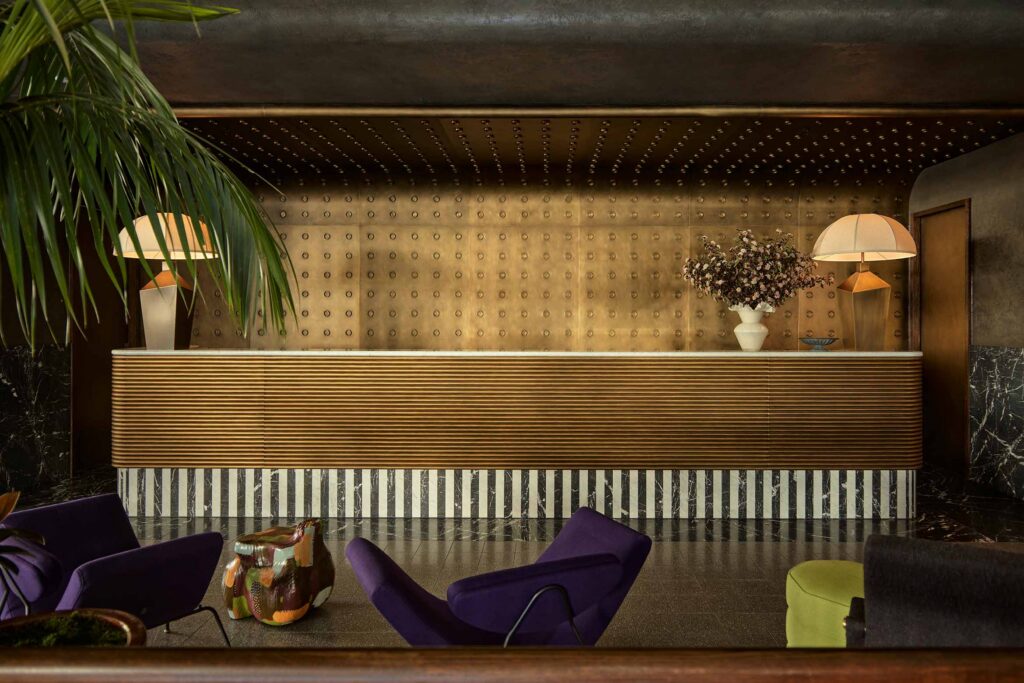
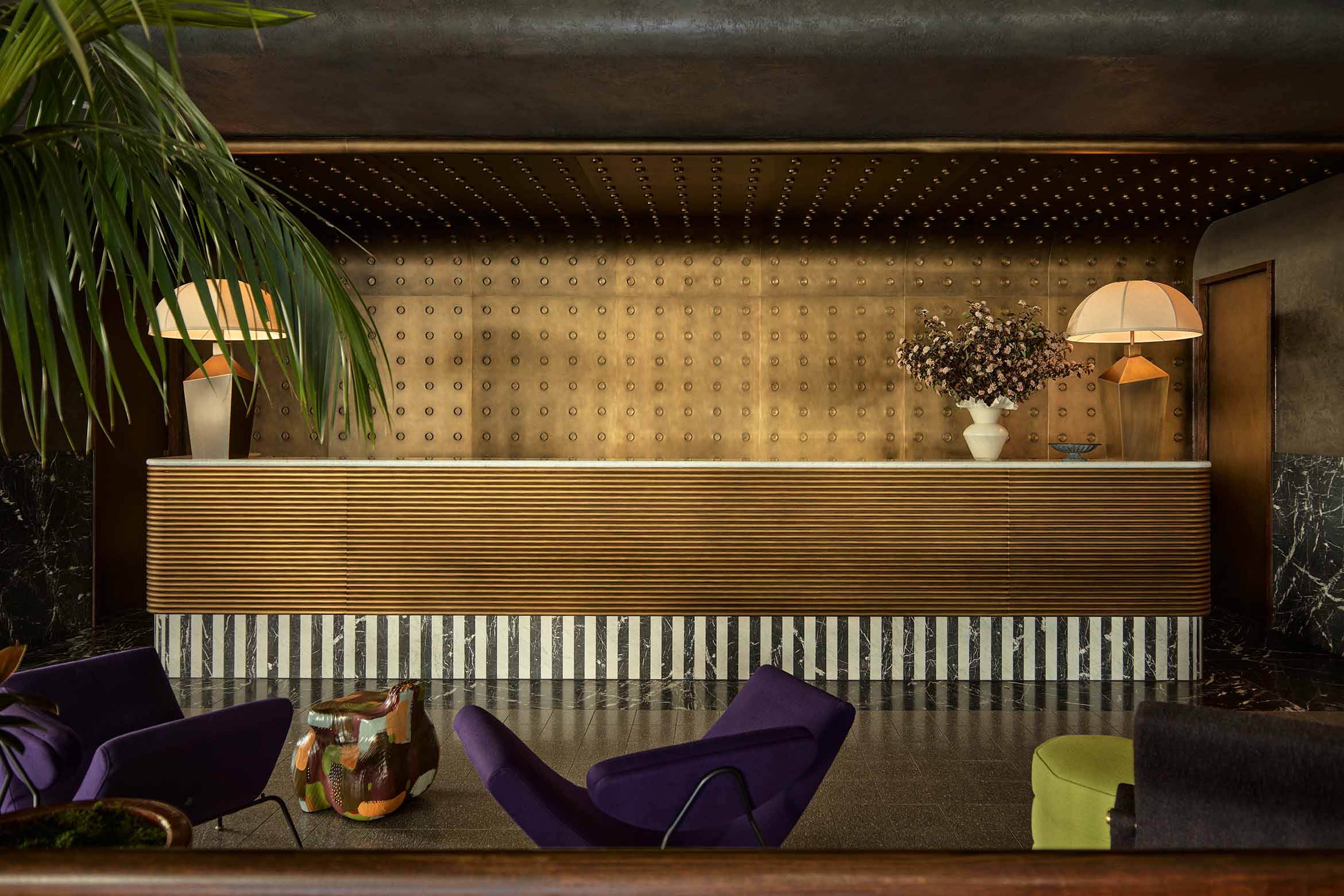
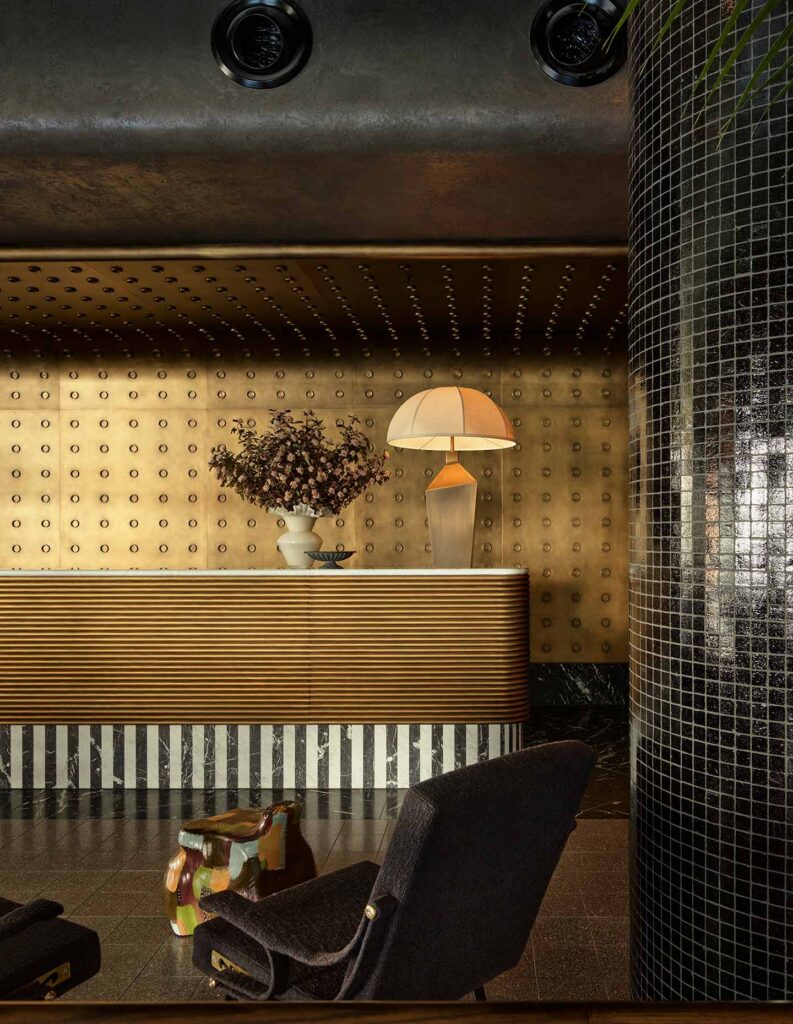
The lobby proper is reached by a two-way staircase, either left to the reception counter for introverts or right to the full lobby for the more flamboyant arrival types. Arranged as a series of open-plan flowing rooms, the lobby starts with a decidedly European reception counter. With a back wall of brass inset with solid brass rings that transitions to the ceiling, the warm tactility of the space is compounded by a brass rung counter, finished with a piano-key stripe of black and white tiles. Bookended by a pair of custom brass lamps, it is a long and luxurious welcome and speaks directly to David Flack’s love for Entryways of Milan, a Taschen publication that explores Milan’s heyday of entrance halls from 1920–1970. A phrase, These Infinite Beginnings, from a poem commissioned for the hotel by Jazz Money, completes the reception.
Being a Flack Studio project, there is marble and stone aplenty with deep red and highly figured Rosa Levanto marble generously applied to the whole staircase and elevator surrounds. Nero Marquina marble, a classic black marble with heavy white veining, forms the outer border of the lobby floor and the floor-to-kickboard junction of the rear wall.
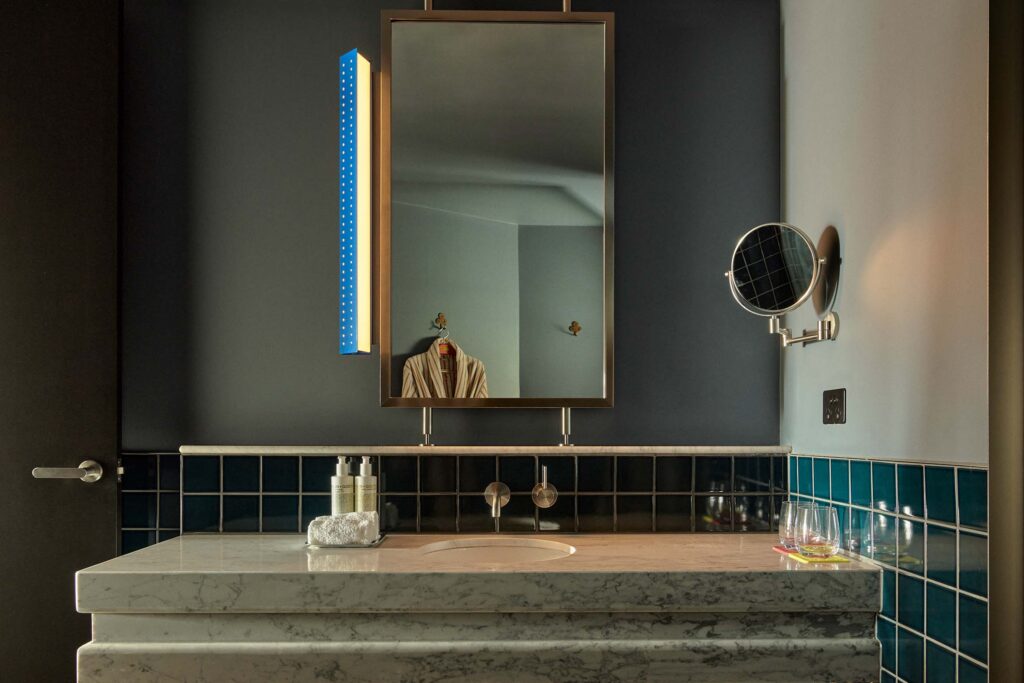
“Different veining, different scales, different histories, the stone palette is deliberately layered. There’s something confident (and indulgent) about that much marble. We embraced it,” says Meredith Hayward, senior designer at Flack Studio.
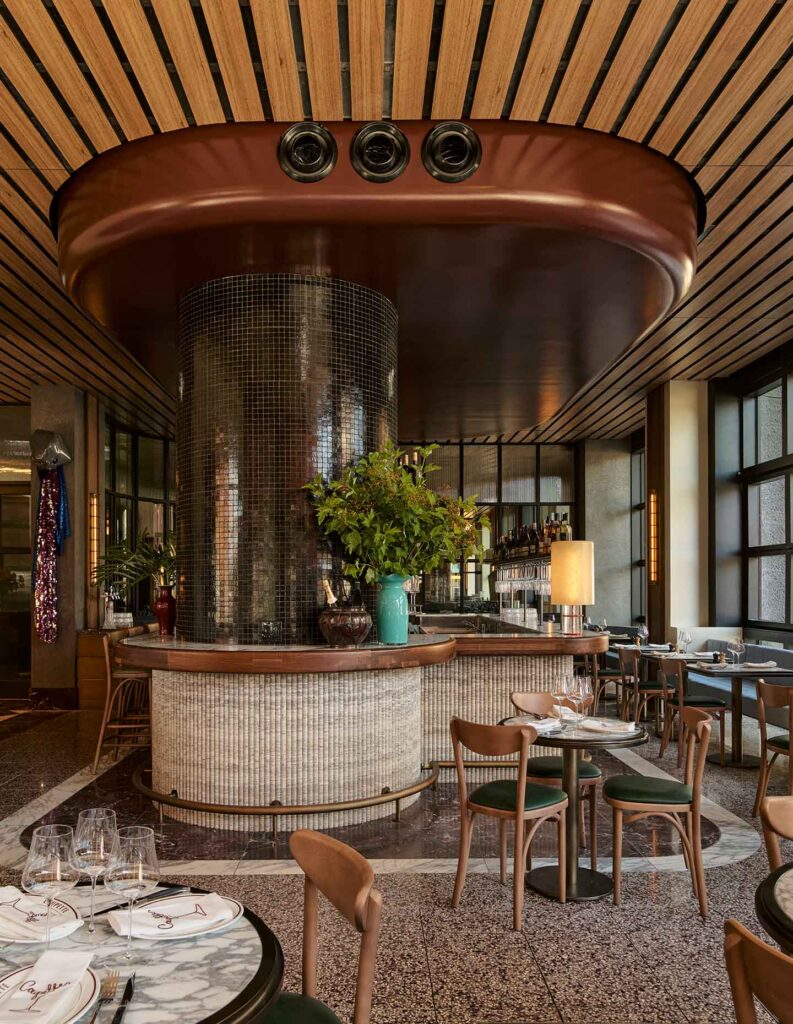
The pillars, however, have been covered in a shiny black tile mosaic, while the main portion of the floor is a caramel terrazzo tile. “We leaned into warm, edible tones – truffle, scorched almond, sparkling Shiraz. The palette feels rich but comforting,” shares Hayward.
The mood is somewhat 1920s, somewhat French brasserie, somewhat Eastern European and very, very Melbourne. Flack explains this direction as a form of modern nostalgia, whereby Melbourne is a destination for so many different nationalities, each bringing their own architectural style, which have coalesced as a hybrid of cherry-picked details.
“Modern nostalgia was tapped into each phase along the design process. You know that weird sense of déjà vu when you walk into a space, as if you’ve been there, or you have this connection to a memory? This plays into the role of creating atmospheres,” says Flack.
This is a strategy he continues, with designers and architects referenced as the space determines.
Joinery, for example, references the furniture of Charlotte Perriand, whose 1920s designs flouted conventional use of timber, leather and stainless-steel tubing. Rather nicely, her bright yellow lights are dotted around the lobby lounges in a nod to Perriand. The lounges themselves are relaxed, with tasselled trims by the bar and stripes in the interior. Art is again everywhere, with a carefully curated selection of artworks from Kat Shapiro Wood, Victoria Stolz, Claudia Terstappen, Georgia Morgan and others.
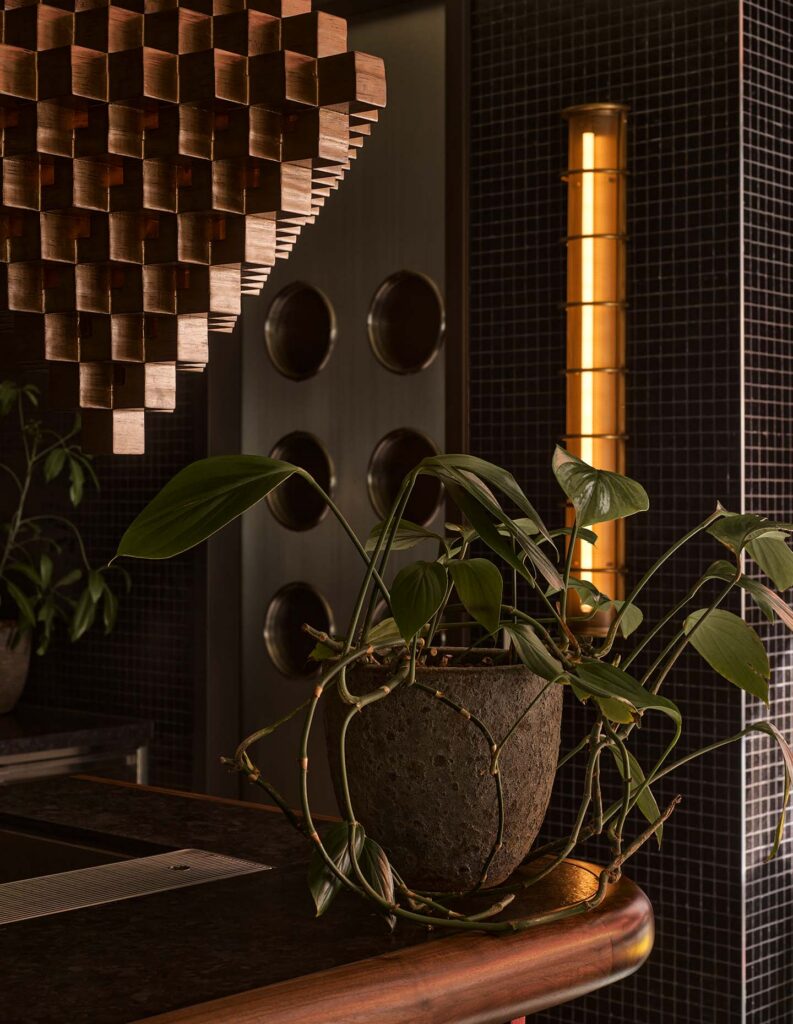
Corridors are given as much attention as any other space, particularly the expanse between the lobby, lounge and restaurant. Here the walls and ceiling have been clad in mild steel that curves at the juncture. It is dark and glossy, a little bit tunnel-like in a cosy interstitial way and decidedly slick.
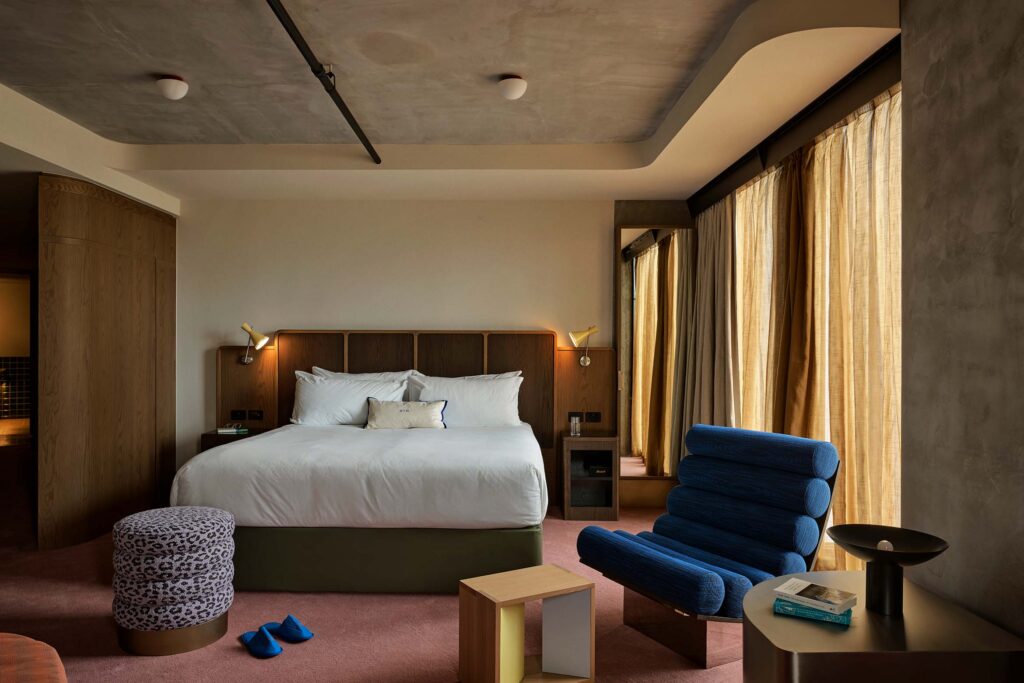
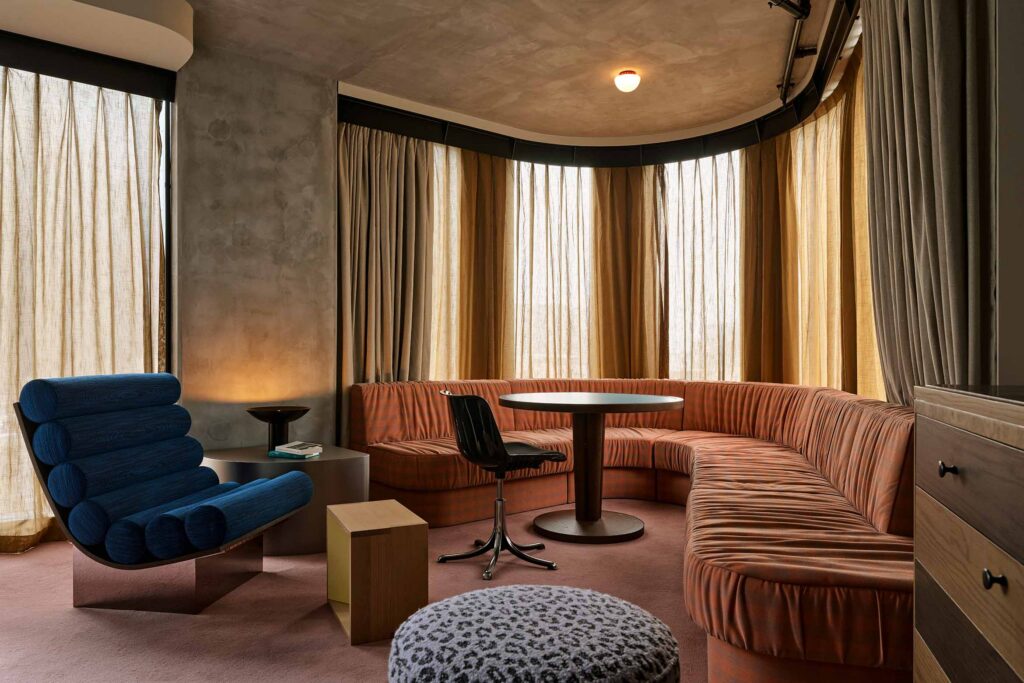
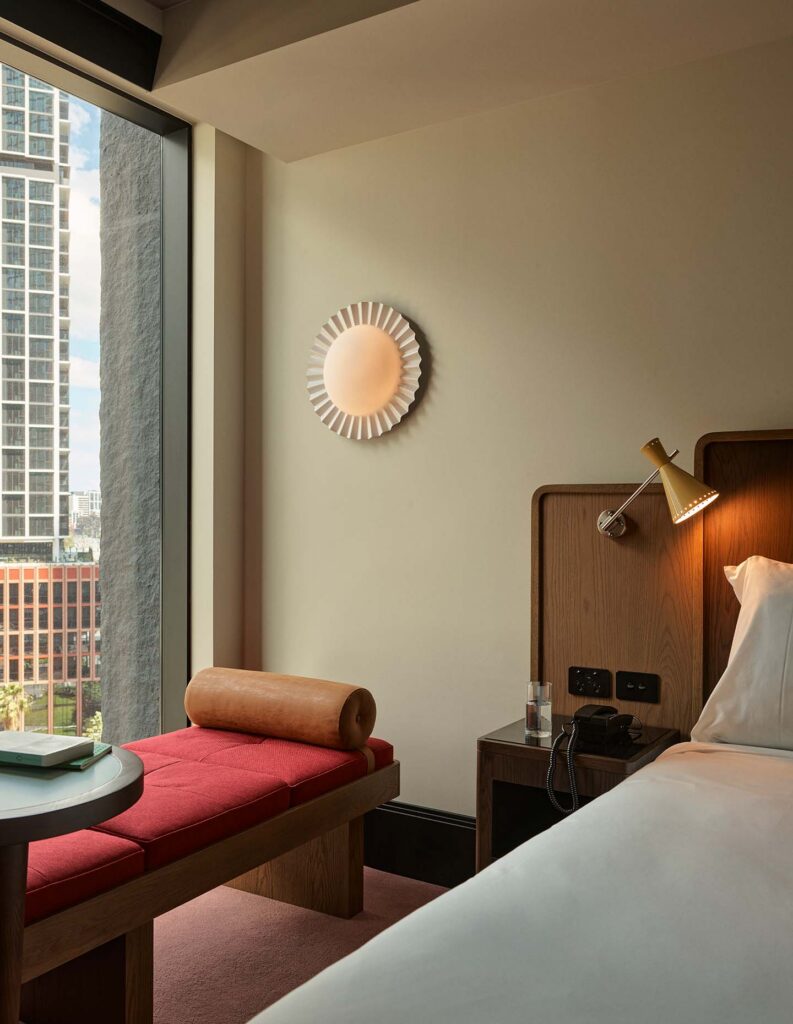
The hotel rooms are likewise considered, with rose-pink carpet an elegant welcoming note. “We chose colours with depth – calm green, dark reds, toasted neutrals, tones that feel almost tactile, and the combinations that we felt were new and old at the same time,” says Hayward.
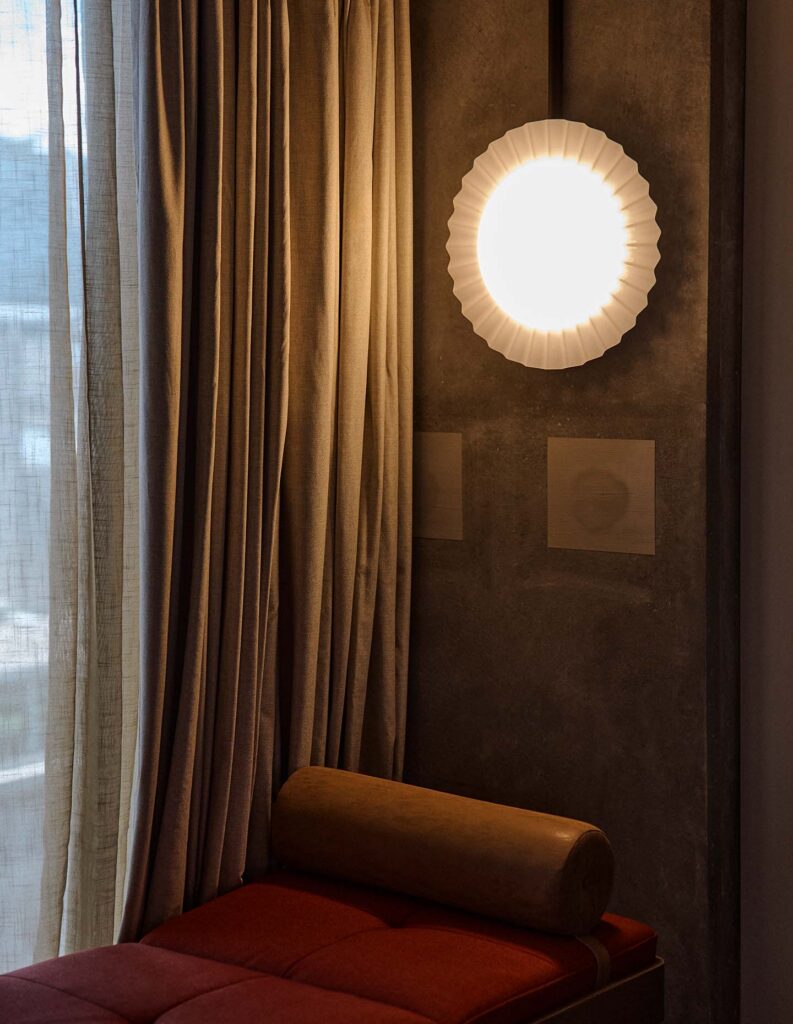
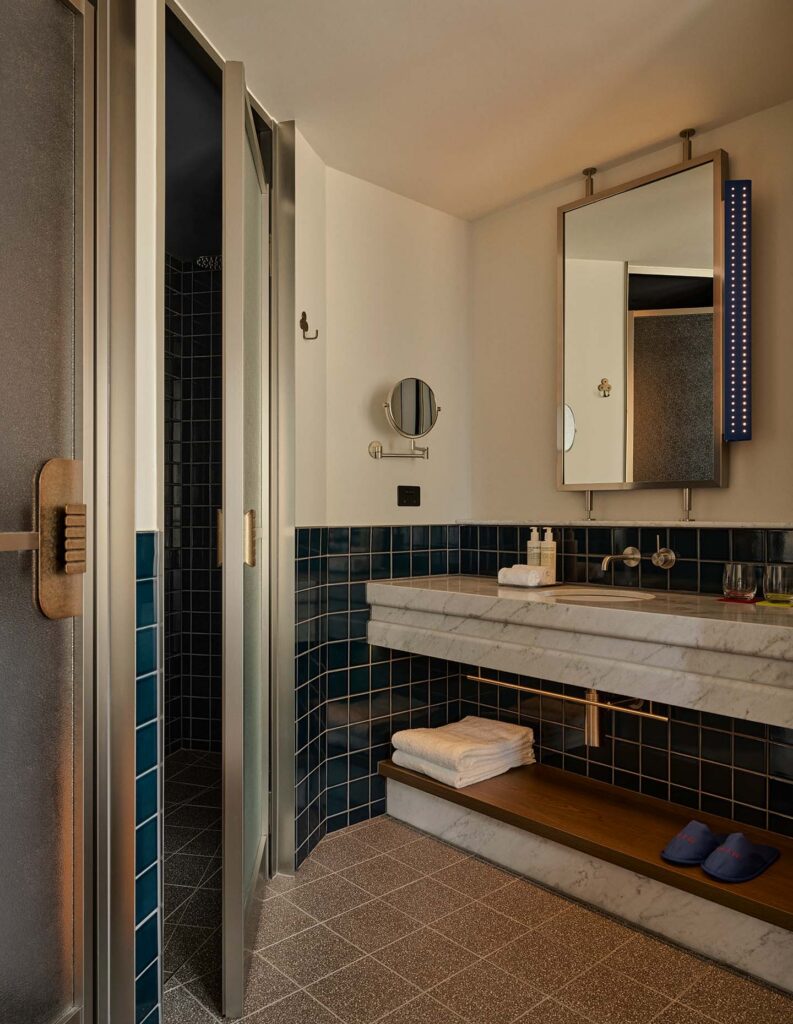
The warmth of the carpet is met with striped marble floor detailing, exceptional cabinetry and ample lounging space, with either a wrap-around banquette in the corner rooms (the building is flatiron-shaped with a decided point towards the city) or a daybed and lounge chair in the more conventional rooms. The bathrooms in deep blue are large, considered (there is a proper door to the bathroom and frosted glass for both the toilet and shower) and have excellent rain showers.
In terms of the project being bespoke, there is one chair in some rooms that was purchased, the rest are entirely designed by Flack Studio. This continues to the public areas, where about half is bespoke or commissioned.
A pool (divine), a deck (fabulous) and an upstairs bar are all treated with the same degree of design-meets-art curation. There is also a degree of cleverness to the design that pushes well beyond considered design. The rooftop bar, for example, is not always open, but rather than have a plain sliding door, Flack has inserted round blue textured glass windows. In the bar itself, a green glass wall is a particularly opulent touch which, when the door is closed, causes the blue glass of the sliding door to shift through the spectrum of colour that green and blue enjoy.
For a hotel with a lot of differentiators, what makes it work is how it feels. It feels like home, or an aspirational version of home that is chic and zhooshy, but also relaxed and easy. If this is modern nostalgia, it’s a genre we can all feel comfortable in.