

This article is from Habitus Magazine. Find out more and subscribe!
There are projects in which decoration dresses a space, and then there are projects where decoration becomes the very narrative of the house.
Exeter House, reimagined by Greg Natale, belongs firmly in the latter category: a richly layered, meticulously orchestrated interior where pattern, texture and history are woven together into an unapologetically maximalist tableau.
The Tudor-style residence, with what Natale describes as “good bones”, had suffered years of unsympathetic alteration. Much of the original detailing had been stripped away: ceiling ornamentation erased, panelling darkened and dulled and spaces repurposed in ways that neither celebrated the architecture nor served a contemporary lifestyle.
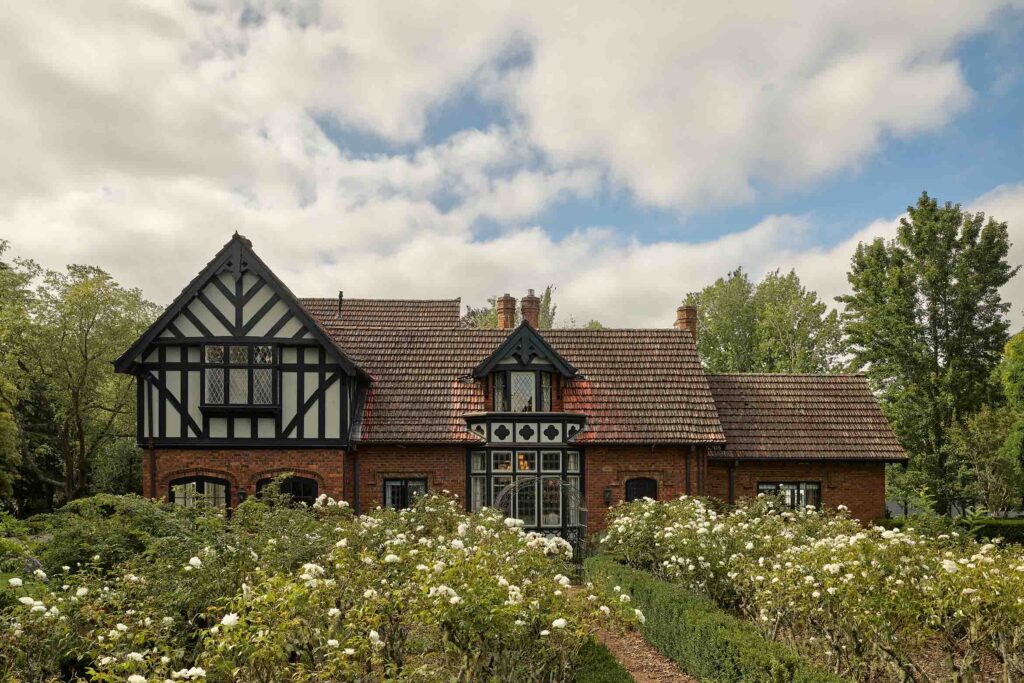
The current owner, a client with both confidence and an appetite for drama, provided the spark. Having fallen in love with the famous London members’ club Annabel’s, he arrived with a clear desire: a home steeped in maximalism – a layered, botanical, almost fantastical interior where every surface could become part of the story. Natale’s response is a project that both honours and amplifies the original Tudor character, while enriching it with a sophisticated language of pattern, colour and texture.
At its core, Exeter House remains resolutely Tudor. The steep gables, leadlight windows and distinctive rooflines are not only retained but celebrated. Natale and his team worked to preserve and reinstate detailing where possible: original doors were kept, the dramatic fireplace retained and existing ceilings treated as anchor points. Where original ceiling ornament had been removed, new detailing was thoughtfully introduced, reinstating the sense of architectural gravitas.
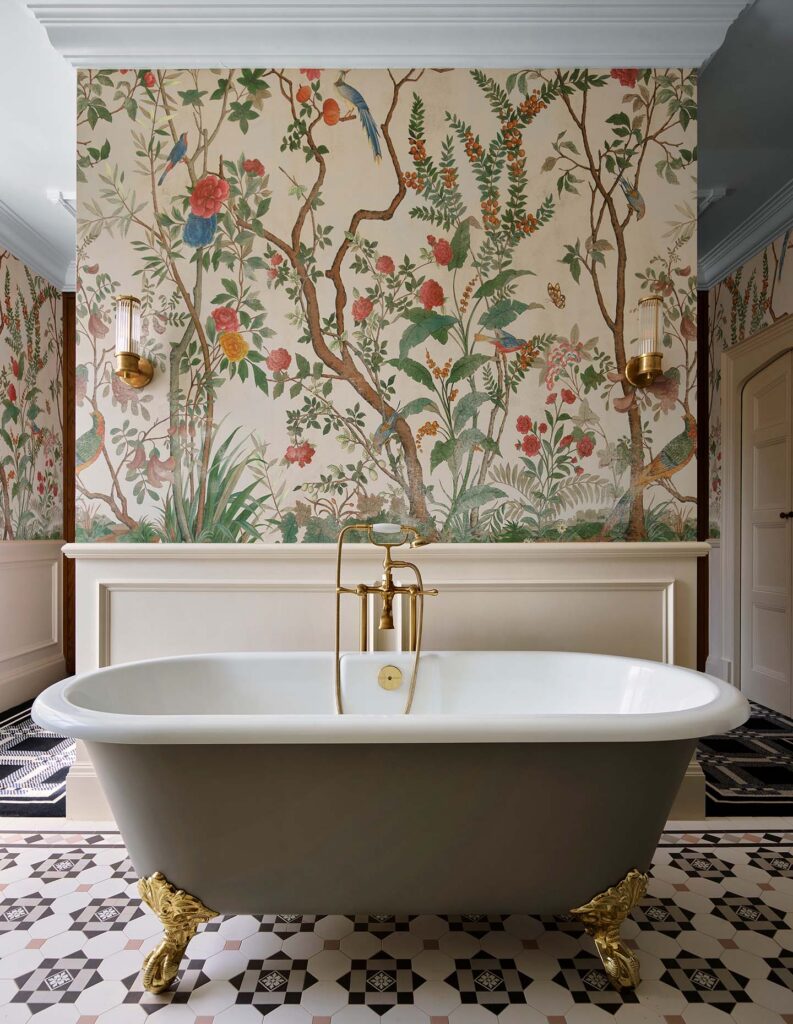
The house, however, is no museum piece. One of the project’s quiet triumphs lies in the new French-pattern timber floors and tessellated tiles that traverse the entry, bathrooms and key circulation spaces. These surfaces are entirely new yet read as though they have always belonged. Their success lies in an exacting calibration of tone, pattern and proportion, creating an underlay that supports the richness above without shouting for attention. As Natale observes, the aim was to make the floors feel “like they were always there”, an ambition that the project fulfils sublimely.
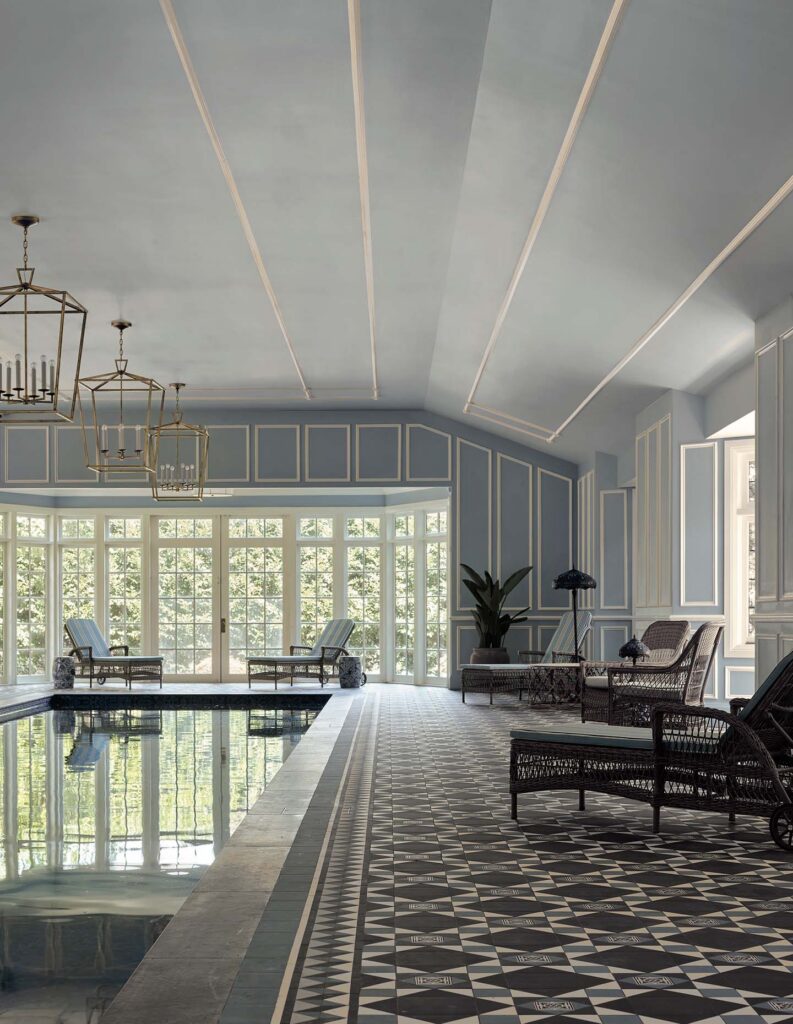
Perhaps the most dramatic spatial intervention is the transformation of the ballroom, which had been used as a car-storage space, into an indoor pool – a true natatorium. As a central experiential axis of the home, the pool is treated as a room in its own right: architecturally framed, visually linked to adjacent bar and lounge zones and folded into the broader narrative of pattern and mood. In this, Exeter House achieves something rare: the pool is not simply a leisure feature, but a theatrical interior element, a kind of shimmering punctuation mark within the composition of rooms.
Related: Raised among the trees
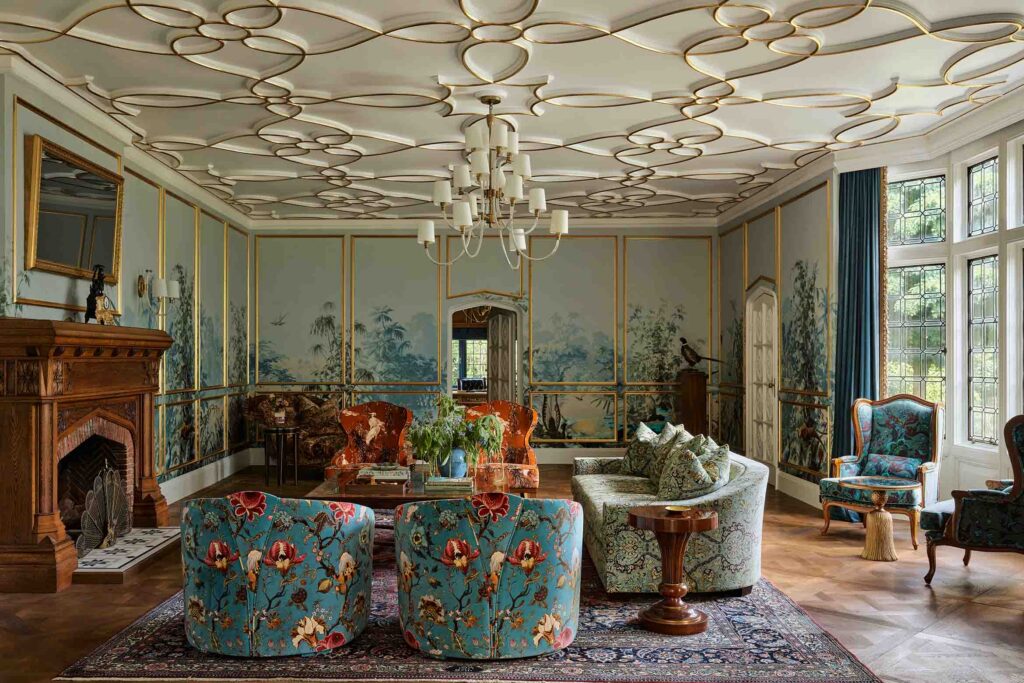
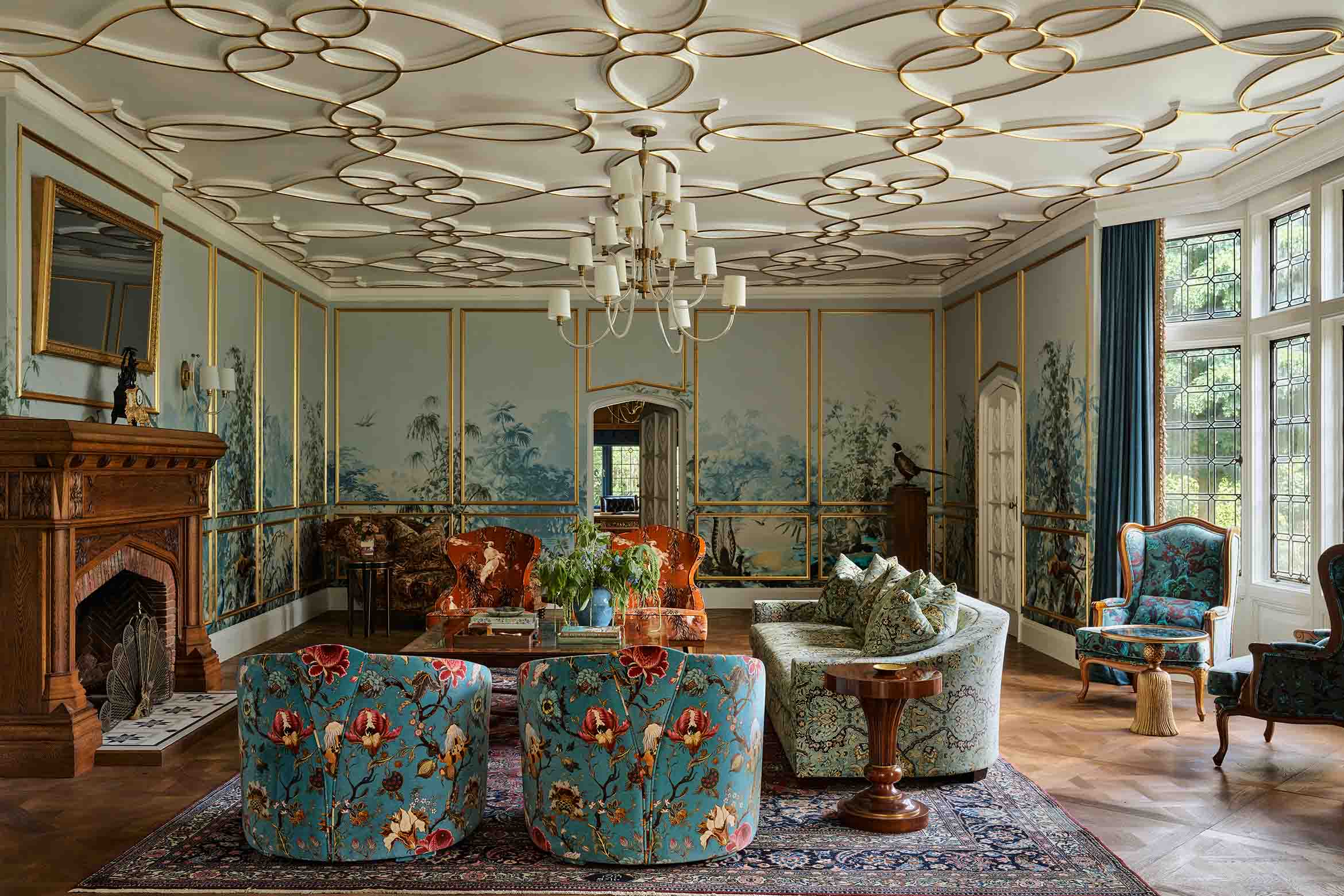
The client’s admiration for Annabel’s manifests as a lavish botanical program that runs throughout the house. Painted wall panels, wallpapers, textiles and art all lean into flora, yet the effect is not chaotic. Instead, there is a deliberate and disciplined orchestration of pattern. The drawing room is the clearest expression of this approach and, for Natale, the heart of the project. High ceilings, a substantial fireplace and leadlight windows provide a dramatic envelope. Within, layers of botanical motifs – on walls, textiles and accessories – are grounded by a gilded ceiling and measured furniture placement. The result is a room that feels at once immersive and astonishingly balanced.
A key to this equilibrium is colour. A pale mint lounge quietly modulates the intensity of the surrounding pattern, allowing the eye to rest even as it takes in the abundance. Elsewhere, rich timber, earthy tones and carefully chosen blues steady the more exuberant floral gestures. The room exemplifies Natale’s assertion that while there is a lot happening, the space remains “easy to read”.
Throughout Exeter House, the boundary between pattern and texture is deliberately blurred. A wall covering in the stair hall, when viewed up close, reveals itself to be made of a subtle plaid, yet from a distance reads as a soft texture. This duality recurs in carpets, wallpapers and upholstery: patterns designed not simply to decorate, but to enrich the spatial experience.
The custom blue plaid stair carpet is emblematic of this approach. It injects rhythm and movement into the vertical circulation, while its restrained palette prevents it from competing with more overtly expressive rooms. In secondary spaces and corridors, if the decorative layers of floral arrangements and accessories were removed, the underlying architecture and furniture composition would be surprisingly minimal. This allows the maximalism to be dialled up or down without compromising the integrity of the design.
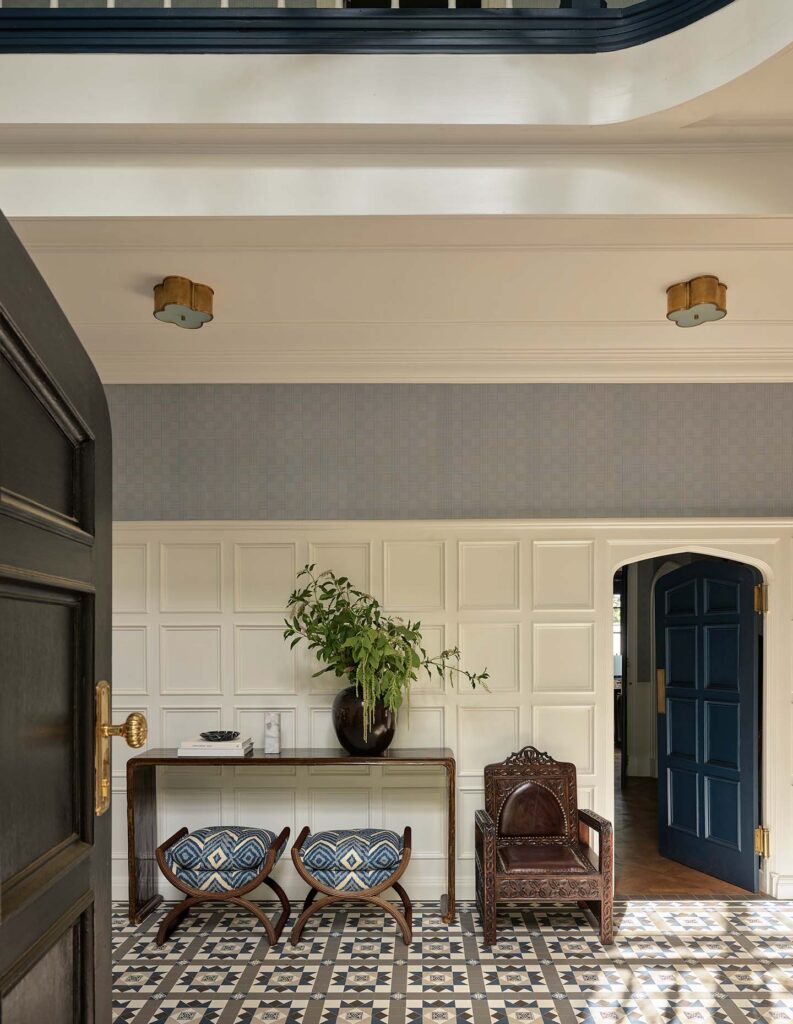
Furniture in Exeter House is knowingly eclectic yet disciplined. The palette spans French Revival and English antiques, contemporary side tables and key signature items such as American chairs by Hickory, a personal favourite of Natale’s. This curatorial mix avoids both historical pastiche and design anonymity. Instead, it sits in that fertile space where heritage forms are rescaled, simplified or accentuated to feel current.
Natale explicitly acknowledges the influence of Dorothy Draper, the iconic American designer and progenitor of Hollywood Regency. Draper’s hallmark strategy – taking Regency forms and amplifying their details to make them more contemporary – finds an echo here in overscaled gestures, bold silhouettes and a confident interplay of high gloss, gilding and saturated colour.
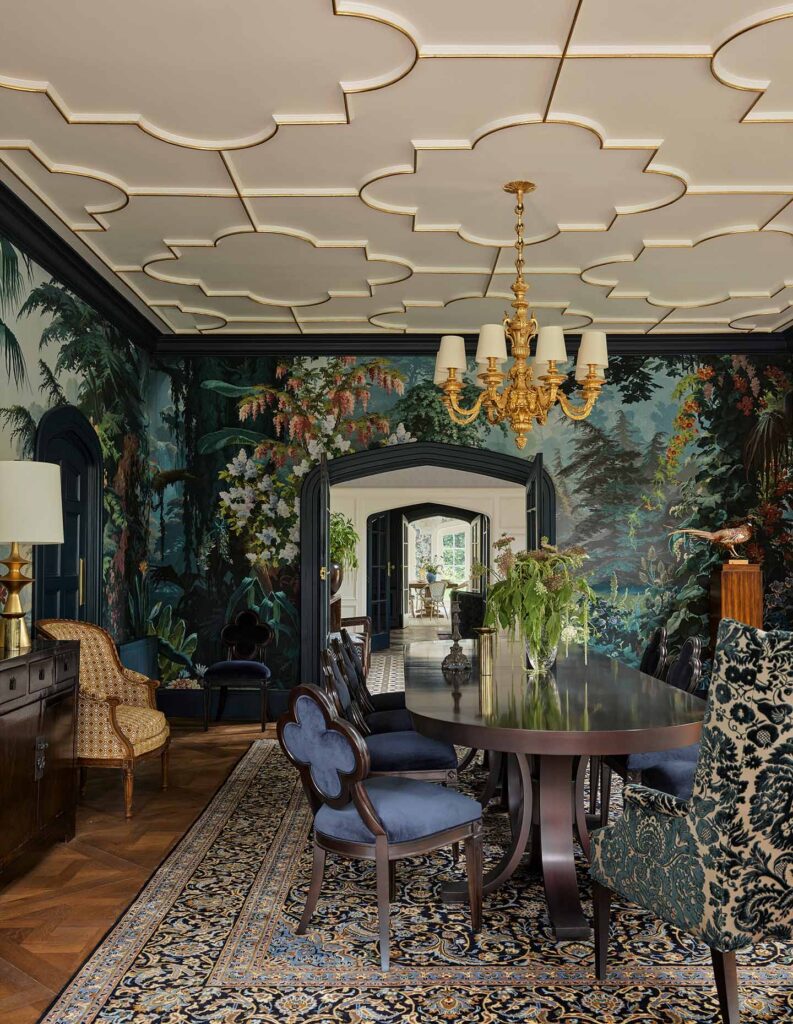
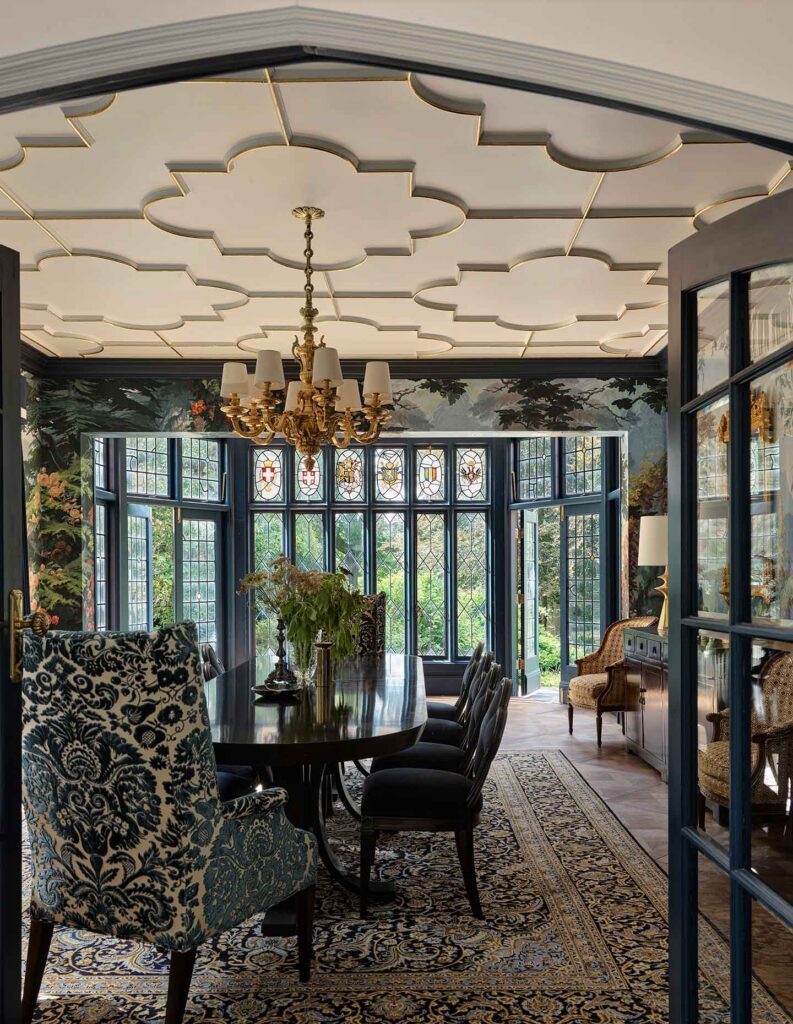
This is particularly evident in the dining room, a moody, cocooning space framed by a wall of botanical imagery at one end and real botanicals at the other. Original gilded chandeliers preside over richly upholstered chairs with velvet inserts and textural rugs. The room is dramatic, but it is also deeply inviting: the kind of interior where long dinners and lingering conversations feel inevitable.
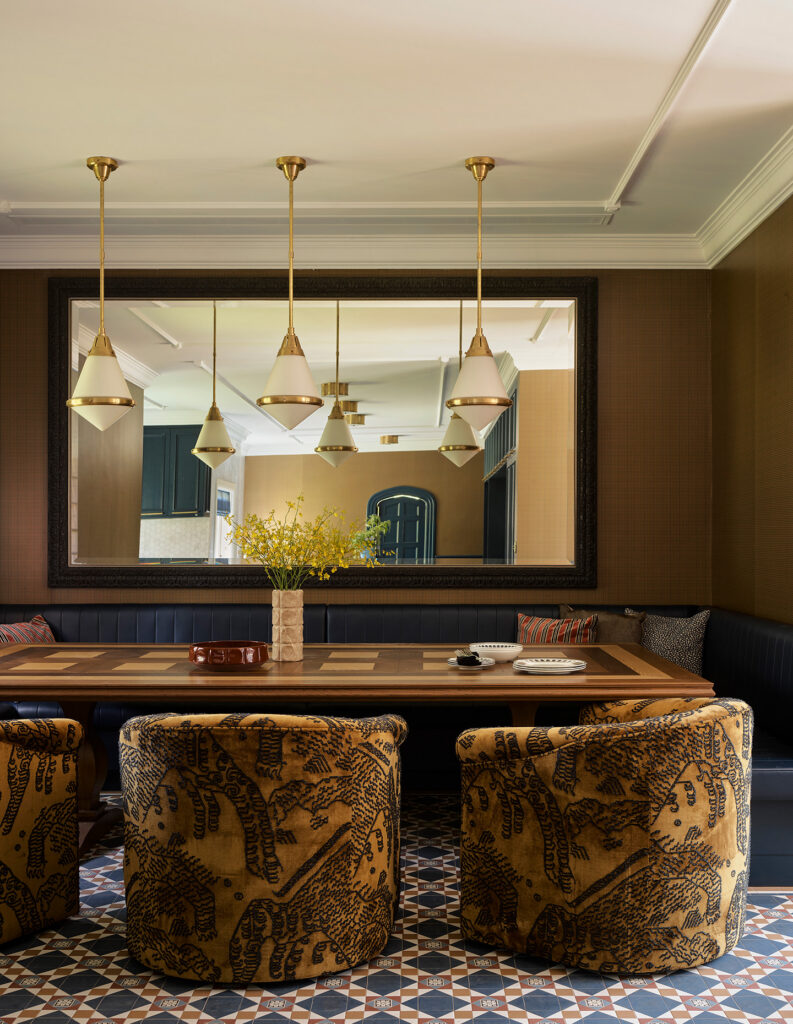
Colour is never simply decorative and Natale makes sophisticated use of blue and brown, a combination steeped in mid-century and Italian design heritage. Here, the project’s adoption of deep and complex blues is part of its charm and unabashed confidence.
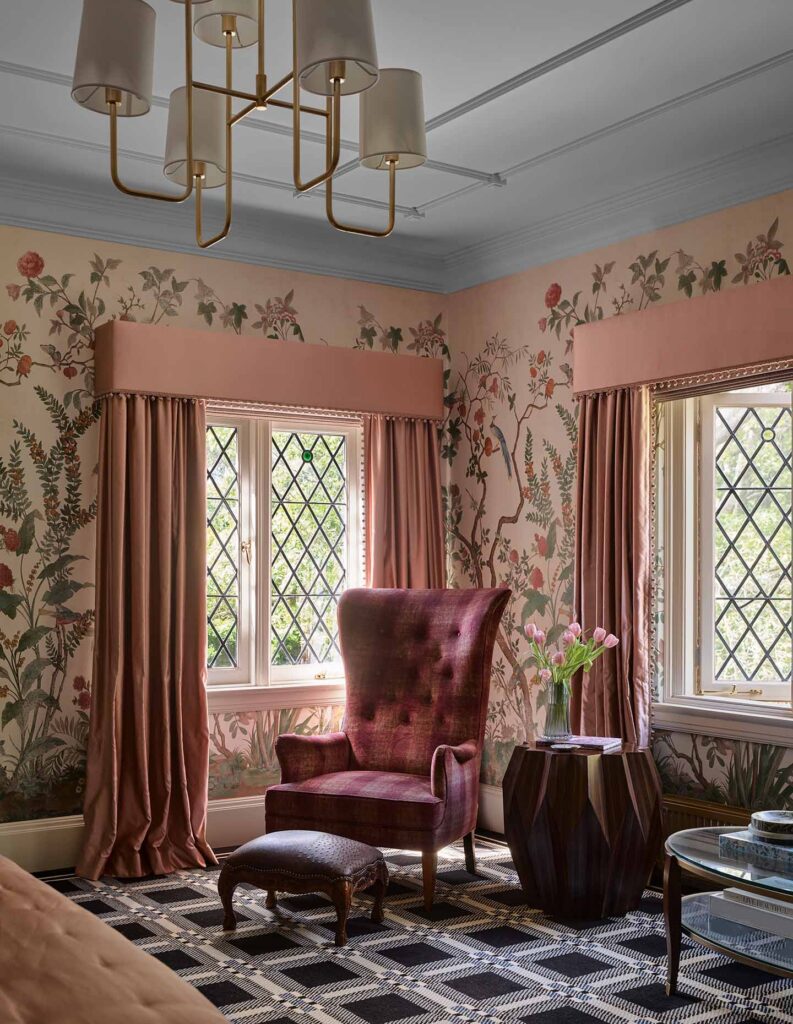
While much of the original panelling has been painted to avoid a sense of heaviness and age, Natale reintroduced timber in the floors and selected furniture pieces to retain warmth and gravitas. This interplay between painted surfaces and natural timber prevents the house from tipping into the overly polished or purely decorative; there is always an earthy note underpinning the orchestration.
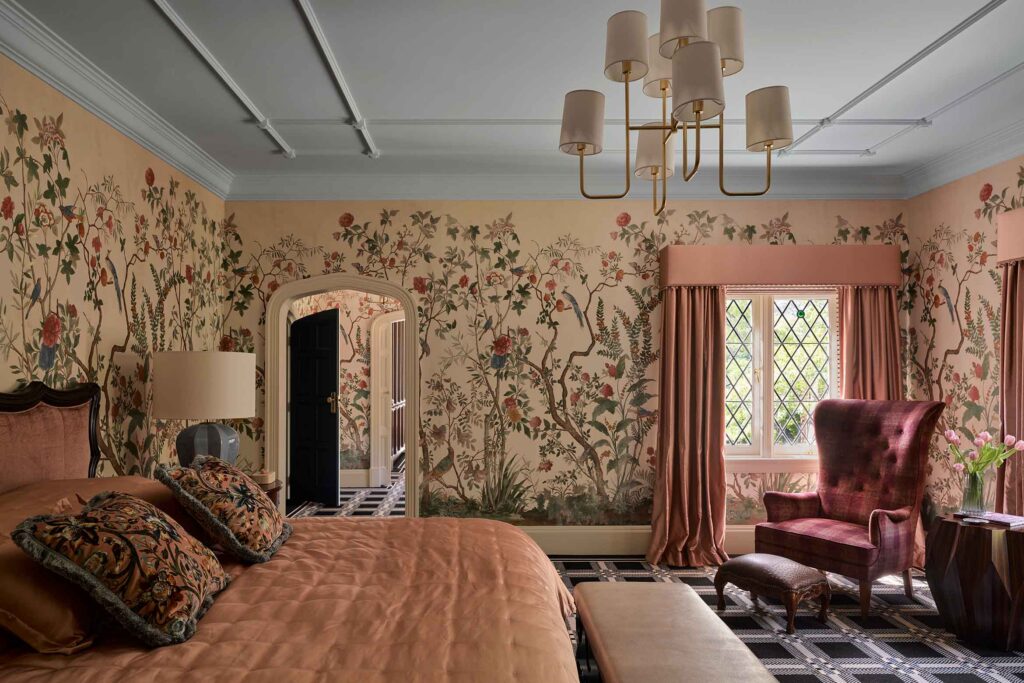
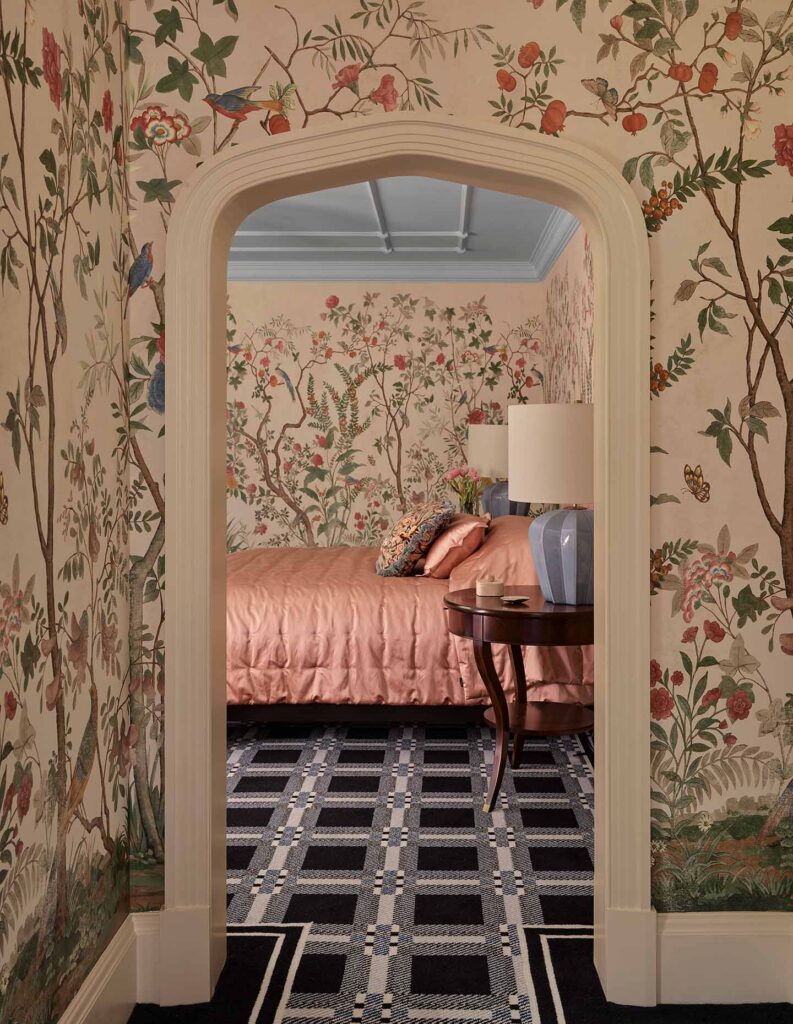
Despite its opulence, Exeter House is first and foremost a family home. Private spaces reflect this: an attic room with antler chandeliers, leather lounges and generous French doors evokes a club-like retreat, while the primary bedroom in pink florals is framed by a wallpapered hall that extends the pattern as an architectural device. Bathrooms continue the wallpaper narrative, layered with marble and finely detailed tiling.
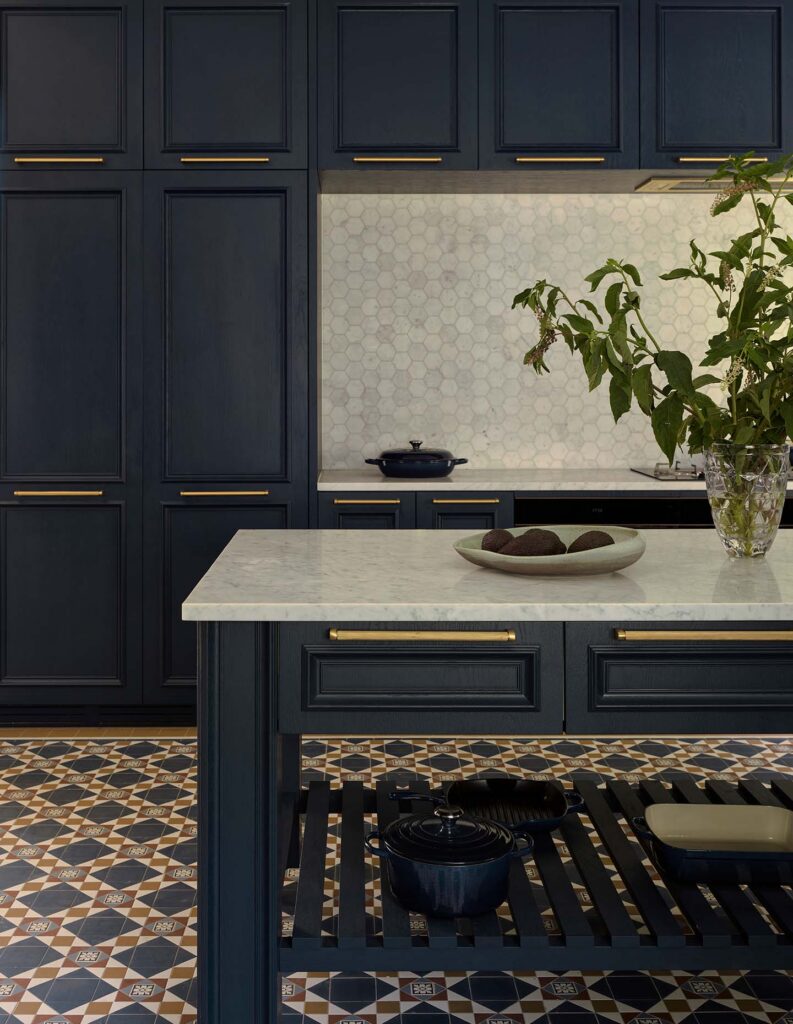
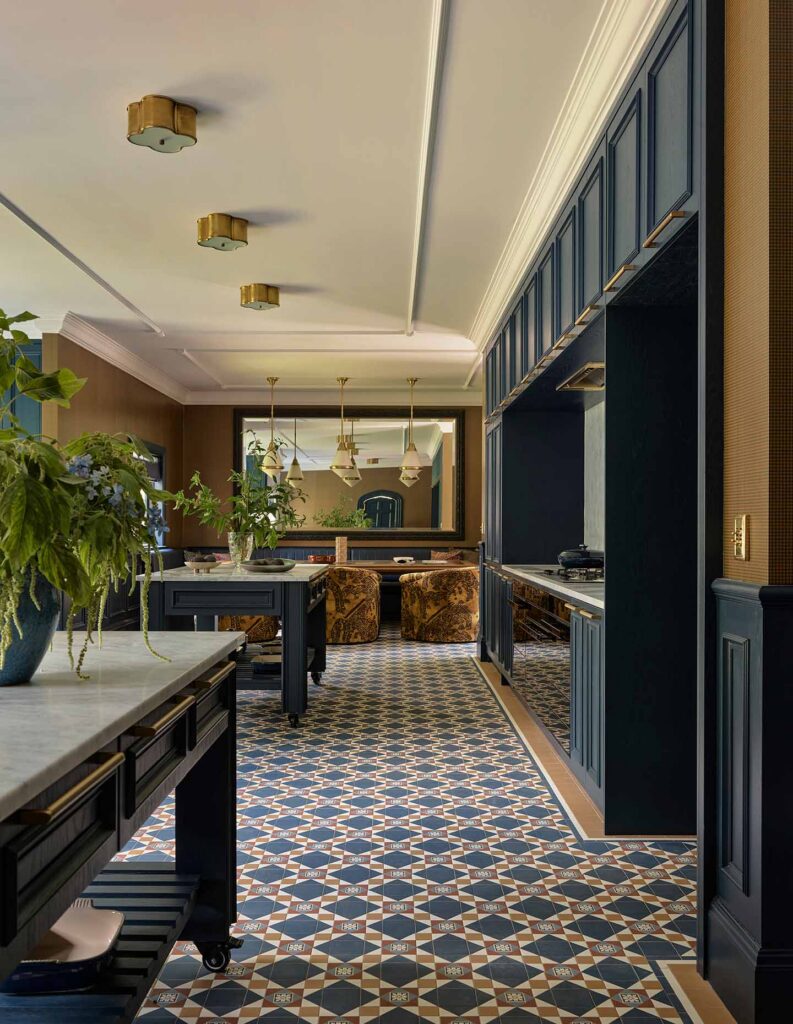
The kitchen is expansive and highly functional, yet visually connected to the broader decorative story. A striking outdoor extension of the kitchen features a copper benchtop with a carefully cultivated patina, while the interior kitchen is dark blue with brass and timber accents. A breakfast nook with caramel bucket chairs softens the grandeur with a note of casual luxury.
Exeter House is, ultimately, a study in how maximalism can be executed with extraordinary control. It is exuberant but not frivolous, daring but not discordant. The Tudor shell is not overwhelmed but rather reanimated, its historic character amplified through a contemporary lens of pattern, colour and texture.
In Natale’s hands, pattern becomes texture, heritage becomes a platform for invention and a once-compromised house finds itself transformed into a richly atmospheric, deeply personal home – one that feels, in the best possible way, like it has always been waiting for this particular story to be told within its walls.